Learning Outcomes:
i. Comprehend the nomenclature of amines, including primary, secondary, and tertiary amines, and the use of prefixes to indicate the number of substituents.
ii. Understand the structural features of amines, including the tetrahedral arrangement of atoms around the nitrogen atom and the presence of lone pairs of electrons.
iii. Explain the concept of basicity in amines and the factors that influence their ability to donate electron pairs.
iv. Analyze the relative basicity of different types of amines, including primary, secondary, and tertiary amines, and the effects of alkyl substituents and substituents on the nitrogen atom.
v. Appreciate the importance of basicity in understanding the reactivity and applications of amines in various chemical processes.
Introduction:
Amines are organic compounds that contain a nitrogen atom (N) bonded to one or more alkyl or aryl groups (R). They are ubiquitous in nature, found in various biological molecules, including amino acids, proteins, and nucleic acids. Amines also have numerous synthetic applications, including as pharmaceuticals, dyes, and catalysts.
i. Nomenclature of Amines:
Amines are classified based on the number of alkyl or aryl groups attached to the nitrogen atom:
Primary Amines: Primary amines have one alkyl or aryl group attached to the nitrogen atom, represented by the general formula RNH2.
Secondary Amines: Secondary amines have two alkyl or aryl groups attached to the nitrogen atom, represented by the general formula R2NH.
Tertiary Amines: Tertiary amines have three alkyl or aryl groups attached to the nitrogen atom, represented by the general formula R3N.
ii. Structure of Amines:
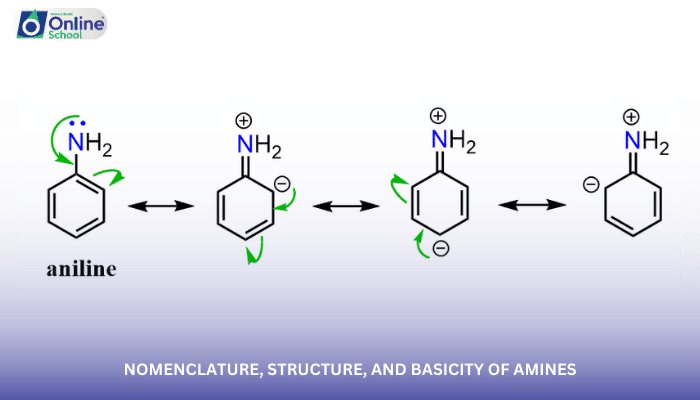
Amines possess a tetrahedral arrangement of atoms around the nitrogen atom. The nitrogen atom forms three covalent bonds with the alkyl or aryl groups and has one lone pair of electrons. This lone pair of electrons plays a crucial role in the basicity and reactivity of amines.
iii. Basicity of Amines:
Basicity refers to the ability of a compound to donate an electron pair to an electron-deficient species. Amines are considered bases due to the presence of the lone pair on the nitrogen atom. The basicity of amines depends on several factors:
Inductive Effect: Electron-donating alkyl substituents increase the electron density on the nitrogen atom, enhancing its basicity. Conversely, electron-withdrawing substituents decrease the electron density, reducing basicity.
Steric Effect: Bulky alkyl substituents hinder the protonation of the nitrogen atom, reducing basicity.
Solvation Effect: The solvent can influence the basicity of amines. Protic solvents, such as water, stabilize the protonated form of amines, reducing their basicity.
iv. Relative Basicity of Amines:
Primary amines are generally more basic than secondary amines, and tertiary amines are the least basic. This trend can be attributed to the increasing electron density on the nitrogen atom with decreasing steric hindrance.
Understanding the nomenclature, structure, and basicity of amines is essential for predicting their behavior in various chemical reactions. Amines are versatile compounds with diverse applications due to their ability to act as nucleophiles, bases, and catalysts. Their basicity plays a crucial role in their reactivity and determines their suitability for specific applications.
